Here at The Hope Rehab Center ‑ known as the top and best rehabilitation center in Pakistan- What drives us to burn the midnight oil is our compassion for young adults who are faced with addiction, self harm or emotional instability. One of our most potent allies in working with youth and adolescents is motivational interviewing (MI) — a counseling method that appeals to young people because it meets them where they are, respects their autonomy, and supports them in discovering their own motivations for change. In this post, we delve deeper into why motivational interviewing is so well suited for youth and adolescents — and how The Hope uses it in combination with compassion, evidence, and expert understanding.
Understanding Motivational Interviewing
Motivational interview was designed by William Miller and Stephen Rollnick as a non-confrontative, client-centered approach to counseling. MI does not promote change, it instead allows ambivalence to be explored and intrinsic motivation and commitment to be developed.
At The Hope Rehab Center, we have embraced this ‘people development’ approach as we recognise many younger individuals are heavily criticised, judged or not listened to by adults. MI provides a place where candid conversation can take place.
Why ‘MI’ is so effective for youth & adolescents
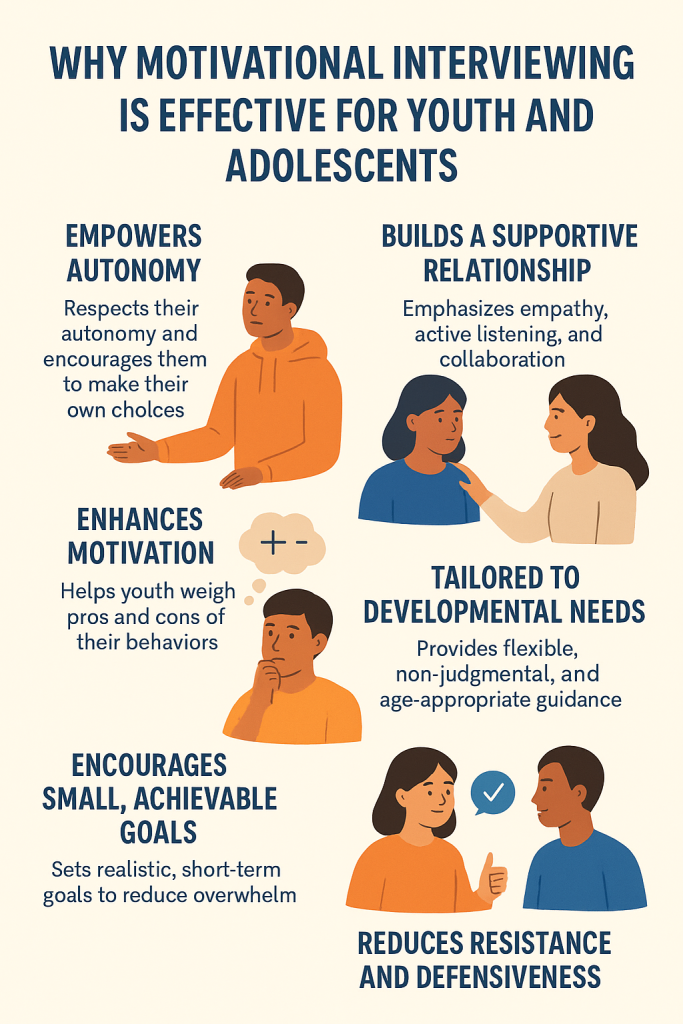
1. Developmentally Sensitive to Adolescents’ Needs
It the teenagers and young adults that is at least different than with other age groups as they forge identities, negotiate peer pressure and, in many cases.\ paddle-to-the-metal liminal period during which they test limits. There is an inherent congruence between motivational interviewing and these developmental tasks. Studies indicate that the relational (empathic) and technical (reflective) signature skills in MI are applicable for adolescents.
So instead of preaching or telling, MI helps young people express what is important to them — values, dreams, goals — and then becomes a bridge for them between their current behavior and their hope.
2. Efficacy in Reducing Substance Use
There is a rich literature that demonstrates the utility of MI for behavior change in adolescents using substances. A meta-analytic review of 21 studies, covering over 5,400 young people, concluded that MI interventions led to small but statistically significant reductions in substance use immediately after and at follow-up.
A further systematic review found that approximately 67% of MI interventions with adolescents produced statistically significant substance-use effects.
MI has been beneficial even in adolescents with concurrent psychiatric disorders. For instance, one research with hospitalised young folks (13-17 years) discovered that MI in conjunction with typical treatment delayed relapse and decreased total substance use over 6 months and even lowered the frequency behaviour.
3. Enhances Engagement & Retention
Among the greatest challenges in child and adolescent care is to get them to stay engaged with treatment. Teenagers do not like to be lectured, judged or misunderstood and will often balk at traditional therapeutic strategies. MI addresses this by establishing relationship, trust and responsability.
For example, a previous study (provided an index of [25], from outpatient substance abuse) that APPAd participants who received feedback using MI had better engagement and greater reductions in substance use than those who did not.
Here at The Hope Rehab Center, we believe every MI session is really a dialogue – not an argument. To help prompt and guide teenagers to their own realizations, counselors employ open ended questions, affirmations, reflective listening and summaries.
4. Works in All Settings – One to One and Groups
MI is versatile. It can be provided in one-on-one or group settings, based on the appropriateness for and preferences of teenagers. This versatility is particularly beneficial in a rehab center environment, as young people can benefit from individual support and peer activation.
In Pakistan for instance, a study has recently assessed Group Motivational Interviewing (GMI) among university going students and it proved to reduce the use of drugs effectively as well as enhancing self-efficacy and well‑being.
Why Motivational Interviewing is Used At Hope Rehab Centre
With such a strong evidence base it is no surprise that the Hope Rehab Center, trying to be known as the top rehab centre in Pakistan, makes motivational interviewing a fundamental skill on our youth focused courses. Here’s where MI is a product of our philosophy:
- Client-Focused Culture: Our therapists are trained to establish a caring, empathic and non-judgmental rapport. We respect the adolescent’s view, guiding them in looking at their own change desires.
- Individualized: We customize MI to each young person’s developmental level, cultural context and personal goals. MI is flexible, whether in group settings, individual guidance or family meetings.
- Evidence-Based Practice: When we use evidence-based practices (like MI), we guarantee our programs are producing real, measurable change.
- Integration with Other Treatments: MI is commonly combined with other treatments (CBT, family therapy or aftercare planning) to up the ante on treatment effectiveness.
- Emphasizes on engagement and retention: It’s known a fact that MI promotes engagement, so we make use of it to keep young participants in the process of their recovery, decrease dropout rates and enhance long-term motivation.
The Special Relevance of MI in Pakistani Context
Given that talking about mental health and substance use can be highly stigmatized in Pakistan, motivational interviewing provides a respectful, culturally sensitive approach to engage with young people. Rather than prescribe values, MI helps young people tell us what they value, fear and yearn for — as they understand it.
As Pakistan’s best rehabilitation center, The Hope Rehab Center is ready to integrate international best practices of MI into the local context — customizing them in culturally appropriate ways and training staff appropriately so that adolescents get a sense of being listened to, feeling understood and gaining empowerment in the process.
Constructing Lasting Change: MI After Rehab Specifically, what is MI?
One of the most important lessons of motivational interviewing is that it develops internal motivation — not short-term compliance. At The Hope Rehab Center, we utilize MI to facilitate young people in connecting with:
- Setting sustainable goals: Youth use their own vocabulary to identify achievable goals in (e.g. remaining sober, returning to school, getting along with others)
- Self-efficacy: Beginning to believe that change is possible and one can make and maintain changes using MI with adolescents.
- Resolving ambivalence: MI helps support them to voice opposing feelings, evaluate the pros and cons of each position, and resolve their uncertainty.
- Relapse prevention: In terms of relapse, MI can build on intrinsic motivation and so help long-term relapse prevention, particularly in addition with some form of booster sessions or post-discharge follow-up.
FAQs
1. What is Motivational Interviewing and how does it apply to youth?
Motivational Interviewing (MI) is a client-centered, empathic style of counseling used to help young people resolve ambivalence about change. MI for youth and adolescents functions by promoting self-expression, increasing motivation, and enabling them to make healthy decisions around issues of behavior and recovery.
2. For what reason(s) do you think MI is particularly suitable for teens?
Adolescents are the stage of identity achievement and are peer influenced as well as value-laden. MI works because it respects their autonomy, involves them in collaborative dialogue and encourages them to act in accordance with their innermost values and goals as opposed to being coerced by some outside force.
3. Will Motivational Interviewing work for young people with substance abuse?
Yes. Studies have found that MI results in significant decrease of substance use among children and adolescents. It enhances participation in treatment, reduces high-risk behaviors, and motivates long-term adherence to sobriety by building internal motivation.
4. How do we use Motivational Interviewing at the Hope Rehab Center?
At The Hope Rehab Center, the best rehab for Pakistan patients, MI is employed in only and group therapies. Our qualified staff establish a safe, non-judgmental space where young people are free to examine issues as they come up while identifying their own goals and creating concrete ideas for moving in a new direction.
5. Does the Motivational Interviewing delivers in Pakistan cultural setting?
Absolutely. MI is culturally sensitive and respects community values, and at the same time encourages young people to speak out. At The Hope Rehab Center, MI is addressed with a culturally-sensitive approach that enables young people in Pakistan feel heard, supported and motivated to make positive changes.
Conclusion: MI as a Core Skill in Using with Clients at The Hope Rehab Centre
At The Hope Rehab Center, we believe that our youth deserve more than just a plan for treatment — they deserve a partnership. Motivational interviewing, the client-centered approach founded on developmental sensitivity that is now well-supported in evidence for its impact, enables us to walk (forward or sideways) alongside the young people to reflect upon change, discover strengths and decide which road they want to stay on.
By making MI part of our programs, we fulfill our mission to be the best rehabilitation center in Pakistan — and not just in terms of facilities; for heart, for expertise, for actual change that lasts.
If you are a young person experiencing problems, or if someone you know is experiencing these challenges, you will be listened to, respected and empowered at The Hope Rehab Center. Motivational interviewing is only one option we use to find hope, meaning, and a future for youth.