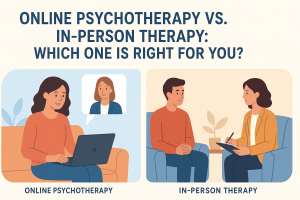
Should psychotherapy–such as the kind we provide under a leading psychiatrist with complete manner of compassionate mental healthcare at Rawalpindi’s The Hope Rehab Center–be done online or in person? That is a question that preoccupies many clients here. In this comprehensive guide, we will compare the two formats and their advantages and disadvantages so you can make your choice.
1. Why it’s Important to Ask This Quest ion: The Emerging Role of Online Psychotherapy
In recent years (sometimes referred to online psychological therapy, teletherapy or internet psychotherapy), therapy has become more widespread. With technology, there’s no longer a need for you to go to the clinic please. Today it is possible to connect with mental health professionals from your own location online. This shift is particularly significant in the case of Pakistan, where a major shortage of mental health professionals exists. According to recent research, Pakistan has very few paedeatric psychiatrists in relation to its population size and mental health services are a significant barrier for those living here.
2. What is Online Psychotherapy?
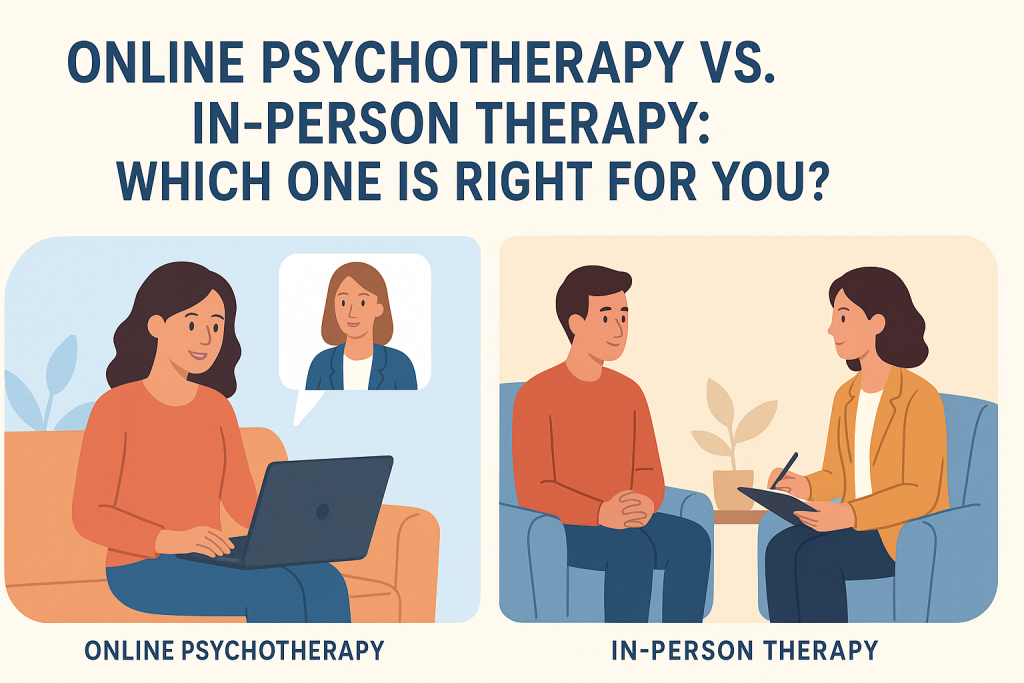
Online psychotherapy is not much different from traditional therapy. It is a way of making use, through video links or phone lines (in the case that one uses control over what occurs on one’s computer systems) and even sometimes text messaging or chat rooms; one can communicate with an approved mental health specialist. Such consultations essentially hope to achieve what might be achieved in a psychological consult: a set schedule involving supplementary contact and good advice.
3. What Is In‐Person Therapy?
In-person therapy is conducted in a physical place–usually an empty office with walls and a door to prevent anyone from hearing your problems being aired where the therapist looks up at you face-to face. This traditional form of therapy is still very effective, whether the problems that it addresses be complex or not.
4. Benefits of Online Psychotherapy
Here are the main advantages of trying online psychotherapy:
1. Convenience & Flexibility
- You won’t have to travel to treatment. There’s no appropriate time of the day to bother packing your bag and clearing out to get there, or which days are better for going without a lunch hour without confusing everyone around with many take-away boxes from different places (yes, even 5 keep a list over next week).
- Virtual sessions provide even greater scheduling freedom than physical sessions. For example, Tamil traders now have meetings back in Chennai for the first time since Windows 10…) They can be held in the evening or at weekends.
2. Equally Contact
Here are some key advantages of going for online psychotherapy:
-
Convenience & Flexibility
-
You don’t need to travel to a clinic, which saves commuting time and cost.
-
Virtual sessions often offer more flexible scheduling, including evenings or weekends.
-
-
Accessibility
-
Online therapy breaks down geographical barriers. Whether someone is in Rawalpindi, a remote town, or simply can’t leave home easily, they can still consult a qualified psychiatrist in Rawalpindi (or other mental health professionals).
-
For people with mobility issues or limited local options, teletherapy can be a game changer.
-
-
Lower Costs
-
Without the overhead of a physical office, online therapy can sometimes be more affordable.
-
Reduced travel expenses also make it cheaper overall.
-
-
Comfort & Privacy
-
Being in your own space (home, or any private environment) can help you feel safer, which may encourage openness.
-
For those who face stigma around mental health, online therapy provides a discreet way to get help.
-
-
Effectiveness
-
Evidence suggests that for many common conditions—like anxiety and depression—online therapy (especially cognitive-behavioral therapy) can be just as effective as in-person therapy
-
3. Lower Overheads
- The savings trickles down directly to you, the patient.
- Travel To save on travel costs, you can be in your pajamas if you wish – at least for the initial visit.
4. Comfort & Privacy
- Being in your own environment (familiar and private) may encourage you to speak freely.
- For people who face stigma or a general reluctance to seek help for mental health problems, See a Therapist on the internet offers an anonymous way of seeking help.
5. Effectiveness
- Evidence shows that for many common conditions — such as anxiety, depression, and bulimia — online therapy (particular cognitive behavioral therapy) can be just as effective as face-to-face treatment. It seems to work well too in many cases of chronic pain and irritable bowel syndrome.
5. Reasons to be Sceptical of Online Psychotherapy
However, online therapy isn’t a complete panacea. Here are some limitations:
1. Technical Challenges
- You need a stable Internet connection, a reasonably current device, and the ability to use digital data.
- Disruptions in sessions through the sheer inability to connect can interfere with therapy.
2. Vital Non-verbal Clues
- Without seeing vital non-verbal cues a therapist might miss significant body language, posture or subtle facial expressions.
- This impairs depth of understanding. With people are not really present in sessions, the therapeutic alliance itself can be at issue.
3. Risks of intrusion into privacy / breaking confidence
- If you conduct a session from home or another nonprivate setting for whatever reason, all bets are off your privacy is as good as shredded.
- You face a possibility of data being divulged if your provider is not secure.
4. Not for Intense Conditions or Emergency Situations
- For people with severe mental illness (e.g., schizophrenia, manic depression) or in crisis, it may be more appropriate to obtain therapy face-to-face.
- There may not exist the necessary infrastructure for crisis intervention sessions when on-line.
5. Distractions
- Temptations to be distracted Home environments contain the inevitable interruptions from family members or pets.
- It may require a greater force of will to approach an Internet appointment as seriously as one conducted face-to-face.
6. The pros of manual aid Here are some of the advantages
1. Deeper connection Also, with nonverbal communication
-
Being in the same room allows your therapist to pick up on nonverbal signals (body language, tone, posture) that are more difficult to perceive online.
-
A physical space creates a professional, neutral environment that helps set the tone for serious therapeutic work
2. Structured, Safe Environment
- The therapy room is a controlled environment without much deflection.
- It helps to break the therapy experience away from one’s daily life, thus aiding in concentration.
3. Better for Complex or Severe Cases
- In-person observation and crisis management tend to be more effective for people who are acutely ill.
- Clinics may also offer a wider range of services (e.g., group therapy, holistic interventions) that cannot be done online.
4. Privacy
- In some cases, in-person sessions may offer better privacy than those online (especially if the home environment is noisy or shared).
7. Con: The Disadvantages
However, “manual assistance” can also have drawbacks:
1. Inconvenience
- Travel time, restrictive hours and commuting costs.
- For busy individuals or those with mobility challenges, attending regularly can be hard.
2. Limited Availability
- In many areas including Rawalpindi or nearby locations, there are not enough qualified mental health specialists. Indeed, reports show that Pakistan has very few psychiatrists in relation to its large population.
- The waiting lists for in-person appointments may be longer.
3. Higher Cost
- A physical office has overhead (rent, utilities), which is passed on to the patient in session fees.
- Travel and other indirect costs (parking, transportation) add up.
4. Stigma
- Some people are anxious about being seen in a mental hospital on account of societal stigma.
- First-time visitors may think it daunting to book an appointment at a prestigious clinic.
In such cases you can use the phone and go there instead (or, in a matchless evolution of technology).
Summary:
8. So, Which One Is Right for You?
Deciding between online psychotherapy and traditional physiotherapy, given the need to visit a psychiatrist in Rawalpindi, you might consider the two options based on your own needs, preferences, and present situation.
1. Assess Your Setup
- Do you have a reliable internet connection and a quiet place?
- If yes: online therapy advisors can offer pieces of information by mail. This method may benefit patients who are seeking convenience and flexibility; even today it ‘s often used across seas.
- If no: in-person sessions may feel better because they will be more confidential and safer.
2. Consider Your Mental Health Needs
- Are you dealing with mild to moderate anxiety, depression or life stress? Online therapy might work perfectly.
- If you have a more serious mental health problem, or have experienced crisis episodes and crises, in-person therapy can offer the kind of depth and structure which is simply not possible online.
3. Think About Your Lifestyle
- If your schedule is packed, or you have difficulties with physical mobility or transportation, online therapy is accommodating.
- If you want a quiet, professional environment where you can “leave your troubles at the door,” in-person might suit you better.
4. Test the Relationship
- Try several online sessions first. Many customers find that once they have built up a relationship with their therapists, virtual therapy becomes incredibly personal.
- Conversely, you might start with person therapy and as your experience with the therapist grows, or convenience becomes more and more important, you will shift to online therapy.
9. Why The Hope Rehab Center?
Our primary aim at The Hope Rehab Center is to give Rawalpindi and beyond high quality mental health care that everyone can access. As a recognized psychiatrist in Rawalpindi, we provide both online psychotherapy and in-person therapy services
- Online Psychotherapy: For those who like flexibility, privacy and continuity without the need to travel.
- In-Person Therapy: It is ideal for deeper psychic work, helping support you in times of crisis or creating strong therapeutic alliances face- to-face.
Our team is committed to narrowing the treatment gap in Pakistan (which has just a few psychiatrists while serving millions). By providing virtual care, we can bridge that gap and make mental health accessible to everybody.
FAQs: Online Psychotherapy vs. In‑Person Therapy — Psychiatrist in Rawalpindi
1. How is online psychotherapy different from in-person therapy?
Online psychotherapy is conducted via video calls, phone or chat, which enables you to be in touch with a therapist wherever they happen to be. In-person therapy occurs face-to-face at a clinic, providing a controlled, professional environment and closer access to other members of staff for help or advice.
2. Can online therapy be as effective as in-person therapy?
Yes. For conditions such as anxiety, depression, and stress management, we know that online psychotherapy works as well or better than traditional face-to-face sessions. However, acute mental health problems are often better treated face-to-face.
3. How can I tell whether online therapy is suitable for me?
Online therapy works best when you have a private area, reliable internet access, and are looking for convenience. It is provided by any qualified providers of psychological care: not one particular brand. If your problem calls for hands-on treatment that cannot be offered through a real-time platform and you have complex needs that are met well in person, face-to-face therapy may prove better suited.
4. Are online therapy sessions with a psychiatrist in Rawalpindi safe and private?
Trusted online therapy platforms and licensed psychiatrists assure that all sessions are completely secure and confidential. Remember to use a private place and secure internet connection to protect your privacy.
5. Can I switch from online to in-person therapy and back again?
Absolutely. Many customers will begin with sessions online for convenience but then take the step up to physical therapy and thus a much more profound therapeutic working over time. of course depends on what suits you and your needs
Final Thoughts
Deciding between online psychotherapy and in-person therapy isn’t an issue of one-size-fits-all Instead, each has its own benefits and drawbacks. The right solution is determined by your situation, how much you can integrate into it with ease, and what your mental health aims are. Whether you prefer the convenience of online sessions or the depth of face-to-face therapy, The Hope Rehab Center will be your beacon. As your peer in Rawalpindi I will be the hand to guide, bend your care around what is (arguably) best for you, and help you on a journey towards healing and restoration.
Want to talk? Contact us right away, and we’ll help you find out if online psychotherapy or face-to-face therapy is right for you. At The Hope Rehab Center, it’s a matter of life or death and you’re never alone.